
Have you ever wondered why some kitchens feel effortless to work in while others leave you constantly running back and forth? The secret lies in a timeless design principle that professional kitchen designers have used for decades: the kitchen work triangle. This simple yet powerful concept can transform your cooking experience from chaotic to seamless, making meal preparation faster, safer, and more enjoyable.
At Al Fanar Group, we’ve designed hundreds of modular kitchens across Oman over our 18+ years of experience. Time and again, we’ve witnessed how the kitchen work triangle principle creates spaces where families love to cook together. Whether you’re building a new villa in Muscat, renovating an apartment in Sohar, or upgrading your kitchen in Nizwa, understanding this fundamental design rule will help you make smarter decisions about your kitchen layout.
The beauty of the kitchen work triangle is its flexibility—it works equally well in compact apartments and spacious villas, adapting to L-shaped, U-shaped, or parallel kitchen configurations. In this comprehensive guide, we’ll break down everything you need to know about this essential kitchen planning concept, helping you create a modular kitchen that’s both beautiful and brilliantly functional.
What is the Kitchen Work Triangle?
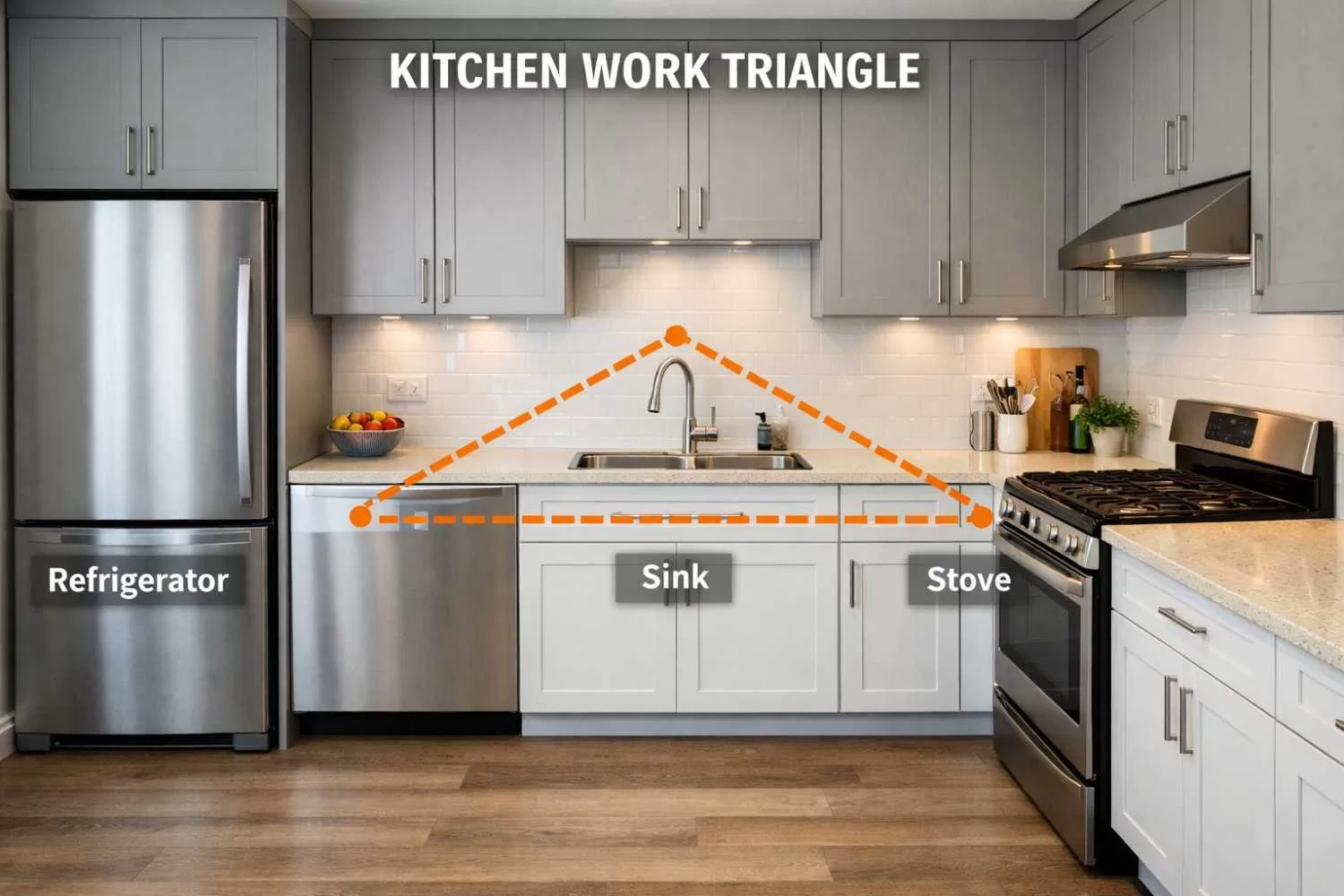
The kitchen work triangle is a design concept that connects the three most important work areas in any kitchen: the refrigerator, the sink, and the stove. When you draw imaginary lines between these three points, they form a triangle—hence the name.
This principle was developed in the 1940s by the University of Illinois School of Architecture and has remained the foundation of efficient kitchen design ever since. The concept is simple: these three zones represent the primary activities in cooking—food storage (refrigerator), food preparation and cleaning (sink), and cooking (stove).
Why the Triangle Shape Matters
The triangular arrangement minimizes the distance you need to walk between these key stations, reducing wasted steps and energy. In a well-designed kitchen work triangle:
- You can move smoothly from refrigerator to sink to stove
- Multiple people can work without bumping into each other
- Kitchen workflow feels natural and intuitive
- Cooking becomes faster and less tiring
The Golden Rules of Kitchen Work Triangle Design
Professional kitchen designers follow specific measurements to create the perfect work triangle. At Al Fanar Group, we apply these proven principles when designing every Centro modular kitchen for our Omani customers.
1. Optimal Triangle Perimeter
The total distance of all three sides of your kitchen work triangle should be between 4 to 8 meters (13 to 26 feet).
- Less than 4 meters: Your kitchen will feel cramped and crowded
- More than 8 meters: You’ll waste time and energy walking excessive distances
2. Individual Leg Distances
Each side of the triangle should measure:
- Minimum: 1.2 meters (4 feet)
- Maximum: 2.7 meters (9 feet)
This ensures adequate counter space between appliances while keeping everything within comfortable reach.
3. Clear Traffic Flow
No major household traffic should cut through your kitchen work triangle. This means:
- Doorways shouldn’t interrupt the triangle
- Family members walking through shouldn’t disrupt the cook
- The path from entrance to dining area should go around, not through, the work zone
4. Unobstructed Movement
Kitchen islands, dining tables, or other obstacles shouldn’t block the triangle’s sides. You should be able to move freely between all three points with items in your hands.
Kitchen Work Triangle in Different Kitchen Layouts
The beauty of this design principle is its adaptability to various kitchen configurations. Let’s explore how the work triangle functions in popular modular kitchen layouts available at Al Fanar Group.
L-Shaped Kitchen Work Triangle
Perfect for medium-sized homes, L-shaped kitchens naturally accommodate the work triangle along two perpendicular walls.
Typical arrangement:
- Refrigerator on one end of one wall
- Sink in the corner or middle section
- Stove on the other wall
This layout is extremely popular in Omani villas and apartments because it leaves space for a dining table or island without interrupting workflow.
U-Shaped Kitchen Work Triangle
Ideal for larger spaces, U-shaped kitchens offer maximum counter space and create a natural work triangle.
Typical arrangement:
- Each major appliance on a different wall
- Creates the most efficient triangle
- Best for serious home cooks
This configuration provides extensive storage and preparation areas while keeping everything within easy reach.
Galley or Parallel Kitchen Work Triangle
Common in apartments, galley kitchens place the triangle along two parallel walls.
Typical arrangement:
- Sink and stove on one side
- Refrigerator on the opposite wall
- Works well in narrow spaces
The key challenge is ensuring the corridor between walls is wide enough (minimum 1.2 meters) for comfortable movement.
Island Kitchen Modifications
Modern kitchens with islands require adapted work triangle principles:
- One point of the triangle often moves to the island
- Creates a larger but still functional triangle
- Popular for open-plan living spaces
Modern Adaptations: Beyond the Traditional Triangle
While the kitchen work triangle remains fundamentally sound, today’s cooking habits have led to evolved interpretations.
The Kitchen Work Zone Concept
Contemporary kitchen design recognizes multiple work zones:
- Consumables Zone: Refrigerator, pantry, food storage
- Preparation Zone: Sink, dishwasher, trash, prep counter
- Cooking Zone: Stove, oven, microwave, cooking utensils
- Non-consumables Zone: Dishes, glasses, serving items
These zones can overlap with the traditional triangle while accommodating modern appliances and cooking styles.
Multiple Cooks, Multiple Triangles
If two people regularly cook together, consider creating two overlapping work triangles:
- Primary triangle for the main cook
- Secondary triangle for the assistant
- Shared central prep area
This approach works especially well in larger U-shaped or island kitchens.
Image 6 Alt Text: Double kitchen work triangle design for two cooks in spacious modular kitchen with Centro cabinets and premium appliances
Common Kitchen Work Triangle Mistakes to Avoid
After installing countless modular kitchens across Oman, we’ve identified common planning errors:
1. Placing the Sink Too Far from the Stove
Many recipes require transferring pots with water from sink to stove. Keep this distance comfortable—ideally 1.2 to 2 meters.
2. Refrigerator in High-Traffic Areas
Don’t place your refrigerator where it blocks the main kitchen entrance. Family members grabbing drinks shouldn’t interrupt meal preparation.
3. Ignoring Counter Space
Each leg of the triangle needs adequate counter space for food preparation:
- Next to refrigerator: Space to set down groceries
- Next to sink: Prep and draining area
- Next to stove: Landing zone for hot pots
4. Dishwasher Placement
While not part of the traditional triangle, your dishwasher should be near the sink (within 90cm) for easy loading and plumbing efficiency.
Planning Your Kitchen Work Triangle with Al Fanar Group
When you choose Al Fanar Group for your modular kitchen, our design experts ensure your work triangle is perfectly optimized for your space and cooking habits.
Our Design Process:
- Space Assessment: We measure your kitchen area precisely
- Lifestyle Analysis: Understanding how you cook and entertain
- 3D Design: Visualize your kitchen work triangle before installation
- Material Selection: Choose from Centro cabinets, TEKA and Bosch appliances, Kayan Marble countertops
- Professional Installation: Expert fitting across all Oman regions
Frequently Asked Questions About Kitchen Work Triangle
1. Does the kitchen work triangle apply to small kitchens?
Absolutely! The kitchen work triangle is especially important in compact spaces. In small kitchens, aim for the lower end of the measurement range (4-5 meters total) to maximize efficiency without feeling cramped. Our Centro modular kitchens are designed to optimize even the smallest spaces while maintaining proper workflow.
2. What if my kitchen has an unusual shape?
Irregular kitchen shapes may not accommodate a perfect triangle, but you can still apply the principle. Focus on minimizing the distance between your refrigerator, sink, and stove while ensuring clear pathways. Our design team at Al Fanar Group specializes in creative solutions for challenging layouts we encounter in Omani homes.
3. Can I have more than one sink or stove?
Yes! If you have multiple sinks or cooking surfaces, choose the ones you use most frequently for your primary work triangle. Additional elements can form secondary work zones. This is common in larger kitchens with prep sinks or separate cooktop and oven.
4. How does the work triangle change with modern appliances?
Modern kitchens might include microwave ovens, coffee stations, and multiple appliances. The core triangle (refrigerator-sink-stove) remains primary, but you can create sub-zones for additional appliances. For example, position your microwave near the refrigerator for easy reheating, or place your coffee maker near the sink for water access.
5. Should my kitchen island disrupt the work triangle?
Ideally, no. If you’re adding an island to an existing work triangle, ensure it doesn’t block movement between the three main points. However, islands can become part of the triangle by incorporating a sink or cooktop. Many of our Al Fanar customers choose islands with prep sinks that complement the main work triangle.
6. What about open-plan kitchens?
Open-plan kitchens still benefit from the work triangle principle. The key difference is managing traffic flow—position your triangle away from the main living area pathway. This keeps cooking activity separate from general household movement. Al Fanar Group’s designs consider both kitchen functionality and social space integration.
7. How much does a well-designed modular kitchen cost in Oman?
Modular kitchen costs in Oman typically range from 1,000 to 4,500 OMR depending on size, materials, and appliances. At Al Fanar Group, we offer customized solutions for every budget, from compact apartment kitchens to luxurious villa installations. Visit our showrooms in Muscat, Sohar, or Nizwa for detailed quotes.
Transform Your Kitchen with Expert Design
Understanding the kitchen work triangle is your first step toward creating a modular kitchen that works as beautifully as it looks. This timeless design principle, combined with quality materials from Centro, TEKA, and Bosch, ensures your kitchen will serve your family efficiently for decades to come.
At Al Fanar Group, we don’t just sell kitchen cabinets—we design complete cooking environments tailored to Omani lifestyles. With 18+ years of experience and four convenient showrooms across Oman, we’ve helped thousands of families create their dream kitchens using proven design principles like the work triangle.
Ready to Design Your Perfect Kitchen?
Don’t leave your kitchen layout to chance. Our expert designers will help you create an efficient work triangle customized for your space, cooking style, and budget.
📞 Call us today for a free consultation: +96895332324
🏢 Visit our showrooms:
- Muscat City Center
- Muscat (Main Showroom)
- Sohar
- Nizwa
🌐 Explore our modular kitchen collections: Click Here
✉️ Get a personalized quote: Contact Us
Transform your cooking experience with a professionally designed kitchen that puts the work triangle principle into perfect practice. Visit Al Fanar Group today—Oman’s trusted name in premium modular kitchens since 2007.